I’m sure you’ve heard things like “zucchini is a heavy producer” and “you only need to plant one” and thought, “Hey! Even a beginner like me can grow that!”
Or at least that’s what I thought.
I figured if I was going to try my hand at squash, I might as well choose a yellow squash variety that the seed packet said was a lower producer. I was still fully prepared to have squash coming out of my ears.
Instead, this season I harvested one yellow squash before my plants were absolutely decimated by pests.
So, naturally, I did what any reasonable beginner gardener would do: I spent several hours on the internet trying to figure out what was killing my plants.
Enter: The Squash Vine Borer

It started with:
“Why is my squash plant wilting?”
And ended with me taking a sharp knife to the stem of my plant and finding a really gross-looking grub wiggling around inside.
Enter the squash vine borer.
Squash vine borers are actually the larvae of a clearwing moth. The adult moths are kind of sneaky because they look a lot like wasps and fly during the day. They lay their eggs around the base of susceptible squash plants, and once those eggs hatch, the larvae burrow into the stems and feed inside them.
And that is where things get really unpleasant for your squash.
The larvae tunnel through the inside of the stem, interfering with the plant’s ability to move water. One of the first signs is wilting, especially when the plant is wilted in the morning when it really shouldn’t be. You may also find small holes and a sawdust-like substance called frass around the base of the plant.
Which, unfortunately, is exactly what happened to me.
Once I knew what I was looking for, I started inspecting my plants much more closely.
And once I found the borer?
Well, I got out my knife.
Apparently, if you catch a squash vine borer early enough, you can carefully cut into the stem, remove the borer, and then cover the damaged portion with soil in hopes that the plant will grow additional roots.
Did this save my plant?
No.
But did I get a small amount of revenge?
Absolutely.
But the Saga Doesn’t End There
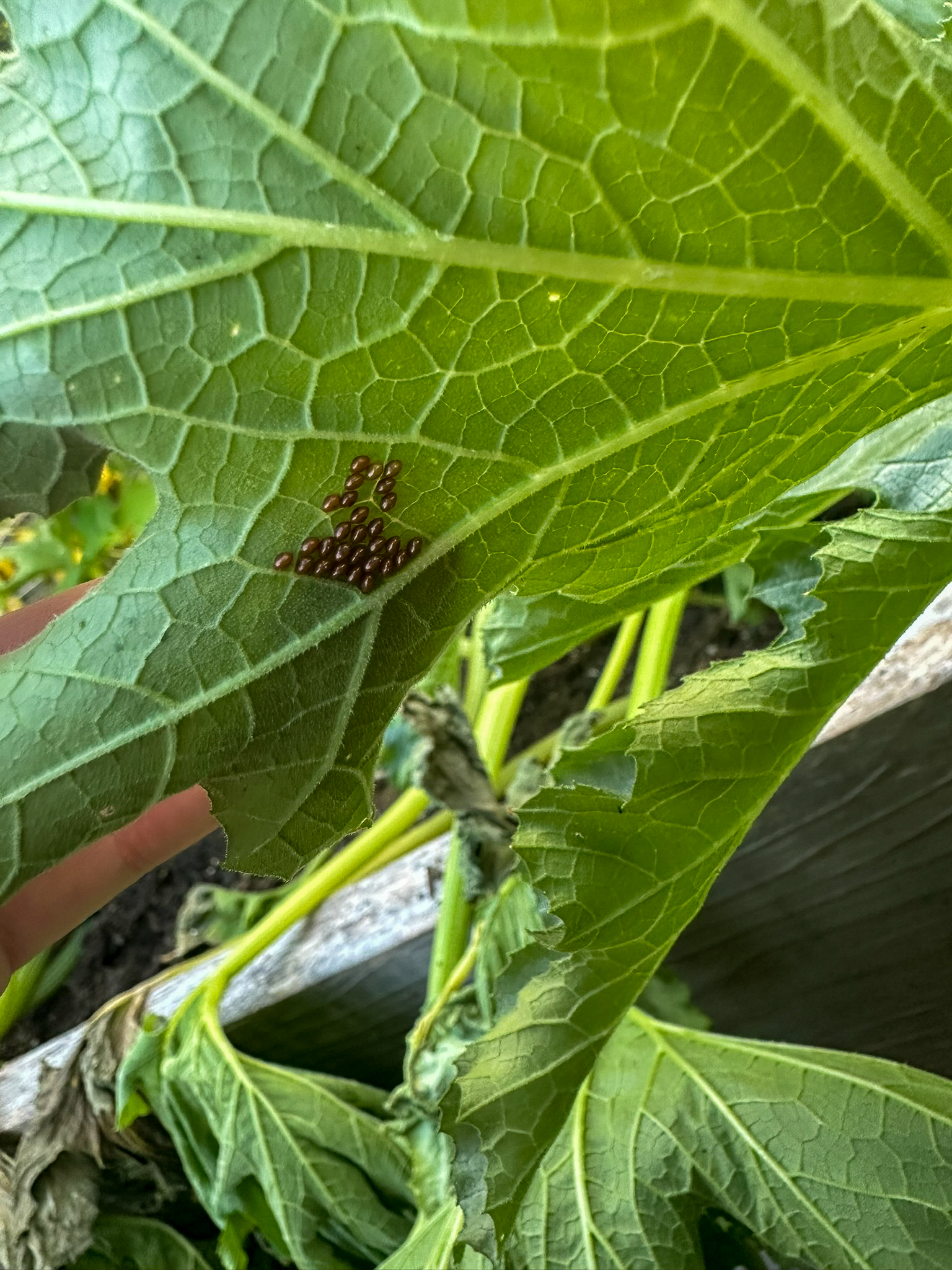
While I was inspecting my squash for more signs of squash vine borers, I noticed a cluster of eggs underneath one of the leaves.


And don’t you know it was a whole new pest.
Squash bug.
Squash bugs are another common pest of squash and pumpkins. The adults and younger nymphs feed by sucking sap from the plant, which can cause yellowing, browning, and, when the damage is severe enough, wilting.
The eggs are usually laid in clusters on the undersides of leaves, often tucked between the veins. The clusters can contain around 20 eggs, and they hatch into nymphs that eventually mature into adults.
So now I had gone from:
“Why is my squash wilting?”
to:
“Oh. There’s a bug inside my plant.”
to:
“Oh. There are MORE bugs laying eggs on my plant.”
Wonderful.
My Very Scientific Pest Control Method
After many more hours of research, I learned that there are a few ways to deal with squash bug eggs.
You can scrape the eggs off into soapy water, crush them, or remove them from the plant while you’re inspecting your leaves. University extension resources also recommend removing adult bugs and nymphs and cleaning up plant debris where squash bugs can hide and overwinter.
I, however, chose a slightly different approach.
I bought a tiny butane torch.
Because apparently my gardening journey has reached the point where I am walking around my garden with a tiny flame looking for squash bug eggs.
In the last few weeks, I have spent many mornings and evenings inspecting the leaves of my squash and other cucurbit plants (including my cucumbers and luffa) as well as nearby plants for these little clusters of eggs.
Armed with a tiny flame and rage.
One plant. Two pests. And one organic gardener determined to kill them all.
Okay, maybe “organic gardener” is doing a lot of work in that sentence.
Safety Note: Yes, I used a tiny torch to deal with the squash bugs, and yes, I’d do it again. That said, using an open flame around plants comes with obvious risks—it can damage your garden and create a fire hazard. If you choose to try anything similar, use extreme caution and be aware of your surroundings. For a safer approach, manually remove squash bug eggs and check your plants regularly.
When to Call It Quits
After spending the last couple of weeks battling these pests and praying that my squash plants could recover, I ultimately decided to cut my losses.
I pulled the plants.
And honestly?
It felt like admitting defeat.
But it also gave me a perfect little space to start some seeds for my fall garden, so I’m choosing to call it strategic crop rotation instead.
Will I Grow Squash Again?
Probably.
Just not yellow squash.
After this year’s experience, I’m not quite ready to give up on squash altogether. I still love the idea of growing my own, but next year, I’m going to try a different variety and a few new tricks.
First, I’ll be much more diligent about scouting for squash vine borers and squash bug eggs. I’ll also look into using floating row covers to protect young plants while the adult squash vine borers are active. Since squash needs pollinators to produce fruit, I’ll have to remove the covers once the plants start flowering.
And, of course, I’ve already picked out a new squash variety to try next year.
Tromboncino (Cucurbita moschata).
I purchased my seeds from Sow True Seed ahead of time so I wouldn’t have to worry about them selling out. Tromboncino is a type of Cucurbita moschata, a squash species generally less susceptible to squash vine borers than the Cucurbita pepo varieties commonly grown as summer squash. It’s not completely pest-proof, but I’m hoping it will give me a fighting chance.
I’m also hoping that switching varieties, keeping a closer eye on my plants, and trying a few preventative measures will help me have a better experience next season.
Because after this year, I’ve learned an important gardening lesson:
Sometimes the best thing you can grow is experience.
And maybe a fall garden where your squash used to be.
Just a note: I’m not affiliated with Sow True Seed, and this isn’t an affiliate link. I bought these seeds myself and am simply sharing where I found the variety I’m planning to grow.
Sources & Further Reading
If you want to learn more about the pests that made my squash-growing adventure such a challenge, these were the resources I found most helpful:
- University of Minnesota Extension — Squash Vine Borers: Identification, life cycle, prevention, and control methods.
- University of Minnesota Extension — Squash Bugs: Identification, damage, and ways to manage squash bugs in the garden.
- Ohio State University Extension — Squash Vine Borer: Ohio-specific information and pest-management resources.


Leave a Reply