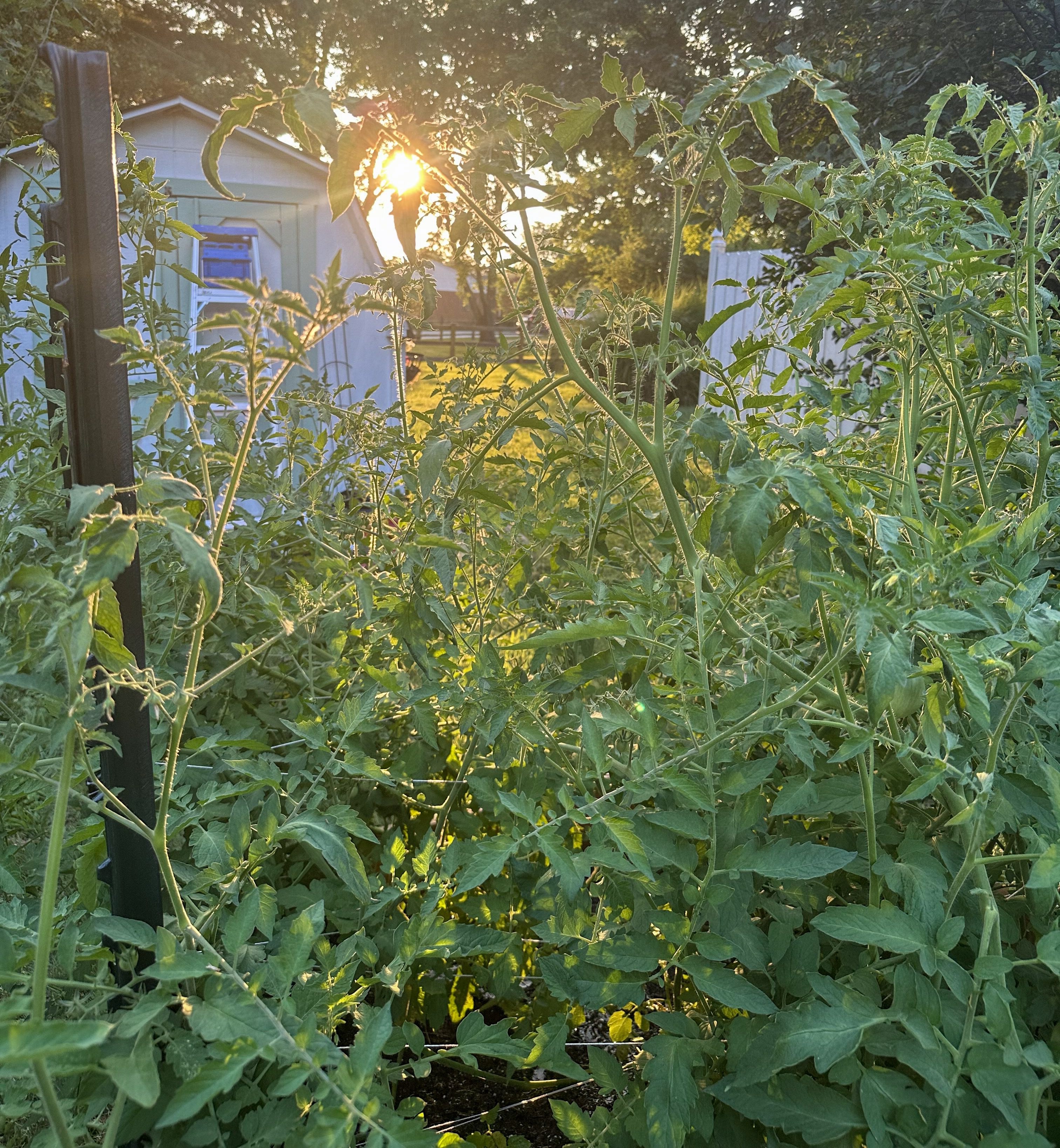
I have a confession to make: I really wanted to love the Florida weave.
It seemed like the perfect tomato trellising solution for my garden. It was inexpensive, customizable, and, most importantly, it promised to keep my indeterminate tomato plants growing up instead of sprawling all over the garden.
And, to be fair, it did all of those things.
But gardening has a funny way of teaching you that something can work perfectly well and still not be the right fit for your garden.
After trying the Florida weave for my tomatoes this year, I have some thoughts.

What Is the Florida Weave?
The Florida weave is a way of trellising tomatoes with sturdy posts and twine. Instead of giving each tomato plant its own cage, you plant your tomatoes in a row and place vertical posts along the row.
Then, as the tomatoes grow, you weave twine between the posts, essentially sandwiching the tomato plants between two layers of twine.
The basic idea is:
- Plant your tomatoes in a straight row.
- Place sturdy posts at the ends of the row, adding more posts if needed.
- Run twine along one side of the tomato plants.
- Bring the twine around the post and back along the other side of the plants.
- Alternate which side of each tomato plant the twine passes as you work your way down the row.
- Repeat as the tomatoes grow taller.
The plants grow up between the two lines of twine, which keeps them supported and, ideally, prevents them from turning into a giant tomato pile on the ground.
The Florida weave is generally best suited to indeterminate tomatoes. These are the tomatoes that keep growing throughout the season and can become very tall when given the right conditions and support.
Determinate tomatoes are a little different. They have a more compact, bushy growth habit and generally reach a set height before producing most of their fruit. They don’t need the same kind of long-term support.
This is the basic stake-and-weave method I followed, with a few adaptations for my own raised-bed garden. If you want to see another explanation of the method, Rutgers New Jersey Agricultural Experiment Station has a helpful guide on the stake and weave training system for tomatoes.
What I Used
For my Florida weave, I used:
- 9-foot T-posts
- A post driver, generously lent to us by our neighbor
- Cotton twine I found at a thrift store
Would I recommend cotton twine for this? Probably not.
A stronger, less flexible twine would be better because cotton twine can stretch and sag as the season goes on. But one of the things I love about gardening is finding ways to use what I already have.
The twine was sitting around waiting for a purpose, so I figured we’d give it a try.
And honestly? It worked well enough.

The only thing I specifically purchased for this setup was the T-posts. They’re one of those things I don’t mind buying because I know I’ll find a dozen uses for them eventually.
I’m already thinking about repurposing mine for a garden fence or maybe a cattle panel trellis.
Stay tuned. I’m sure I’ll find a use for them.
What I Liked About the Florida Weave
It is more customizable than tomato cages
One of my biggest complaints about traditional tomato cages is that they are, well, cages.
They have a fixed height and width, and once your tomato plant outgrows the cage, you don’t have a whole lot of options.
This is especially true for the indeterminate tomatoes I grow, which can quickly outgrow the average tomato cage and keep growing long after they’ve reached the top.
The Florida weave is much more flexible. You can keep adding layers of twine as the plants grow, giving you more control over how tall your support system becomes.
In theory, anyway.
I’ll get to that part in a minute.
It keeps the plants upright and off the ground
This is the whole reason I trellis my tomatoes in the first place.
Tomatoes are much easier for me to manage when they’re growing vertically instead of sprawling across the soil. I also like keeping the foliage and fruit away from the ground, especially when we’re getting one of those good summer downpours that sends soil splashing everywhere.
And in that respect, the Florida weave did exactly what I wanted it to do.
My tomato plants stayed upright, and my tomatoes weren’t laying all over the ground.
Success!
It is relatively inexpensive
The Florida weave can be a pretty budget-friendly way to support a lot of tomato plants.
In my case, the only thing I bought specifically for the project was the T-posts. The post driver was borrowed from our neighbor, and the twine was thrifted.
I love a garden project that doesn’t require a trip to the garden center for 17 different things I didn’t know I needed.

What I Didn’t Love About the Florida Weave
This is where things get a little more complicated.
The Florida weave worked.
I just don’t think it worked for me.
It requires a lot of maintenance
The biggest downside for me was how often I needed to add more twine.
When my tomato plants started taking off, we were out in the garden every couple of days adding another layer and trying to keep everything supported.
I genuinely love being outside in the garden. But after a few weeks, it started to feel less like a fun garden task and more like a chore I was trying not to forget.
It doesn’t work as well when your plants grow at different rates
In an ideal world, all of your tomato plants would grow at roughly the same pace, and your perfectly organized row would fill out beautifully together.
My garden, of course, did not get that memo.
I had one tomato plant that was significantly taller than the others. I ended up doing some creative things with the twine to keep that one supported while I waited for the rest of the plants to catch up.
It wasn’t impossible, but it was awkward.
The Florida weave seems to work best when you have a relatively uniform row of plants that are all growing at approximately the same rate.
My T-Posts Weren’t Tall Enough
This was a problem I didn’t really anticipate until I was already in the middle of the growing season.
All of my tomatoes this year are indeterminate, which means they have the potential to grow very tall. I knew traditional tomato cages wouldn’t be tall enough for the varieties I was growing, which was one of the reasons I wanted to try the Florida weave in the first place.
The problem is that I’m growing my tomatoes in raised beds.
My T-posts are 9 feet long, but roughly a foot of that needs to be in the ground for stability. Then, because my tomatoes are growing in raised beds, the height of the bed itself takes up several more feet of that potential trellising height.
Suddenly, my 9-foot T-posts weren’t looking quite so tall.
The plants kept growing, but I was running out of room to add layers of twine.
This is something I’ll need to think about if I try another version of this system in the future. I may need taller posts—or I may need a completely different trellising method.
Everything Becomes a Jungle Very Quickly

This was probably my biggest issue with the Florida weave.
Once the tomatoes really started growing, the plants began blending together at the top. It became difficult to see the individual plants, find all of the tomatoes, and—perhaps most importantly—find all of the suckers I wanted to prune.
If you’re new to growing tomatoes, suckers are the little shoots that grow from the junction between a main stem and a leaf branch. Whether or not you should remove them depends on the type of tomato you’re growing and how you want to manage your plants.
If you want to learn more about pruning tomato plants, these are two resources I found helpful:
Tomato Pruning – Wisconsin Horticulture
How to Prune a Tomato Plant for Bigger Harvest – Bonnie Plants
I May Have Planted Them a little too Close
I also have to admit that some of this may have been my own fault.
I planted six tomato plants in a 4-by-4-foot raised bed. That’s 16 square feet of growing space, or about 2.5 square feet per tomato plant.
While that might sound like plenty of room, it wasn’t quite enough for the way I was growing my tomatoes with the Florida weave.
As the plants filled in, I found myself doing more pruning than I normally would. I needed to open them up to improve airflow because our hot, humid summers can make keeping tomato foliage dry and healthy a bit of a challenge.
And, as anyone who gardens in the Cincinnati area knows, we have no shortage of humidity.
I think this is where the Florida weave and my preferred gardening style started to clash.
The Florida weave seems particularly well suited to traditional row gardening, where you have a longer, narrower space and can give your tomato plants plenty of room to spread along the row.
But I live in the suburbs, and I have limited garden space. Square-foot gardening is much more practical for me.
I like being able to make the most of every little bit of space I have, even if it means my garden occasionally resembles a game of tomato Tetris.
The Square Foot Gardening method is designed around making the most of limited growing space. You can learn more about the method and its principles from the Square Foot Gardening Foundation.
For me, though, I think I need a trellising method that better matches the way I grow.
Would I Use the Florida Weave Again?
For tomatoes?
Probably not.
And that’s okay!
I don’t consider this experiment a failure. The Florida weave did exactly what it was supposed to do: it supported my tomato plants and kept them off the ground.
But gardening isn’t just about finding something that works. It’s about finding something that works well for you.
For me, the constant maintenance, the uneven growth, the limited height, and the jungle that developed at the top of the plants outweighed the benefits.
I also think my limited space and preference for square-foot gardening make a different trellising system a better fit.
Interestingly, I tried a similar twine-support method with my sugar snap peas, and it worked beautifully.
So I’m not giving up on the idea entirely. I just think my tomatoes and I need to go our separate ways.
Two Tomato Trellises I Want to Try Next
There are two other methods I’m curious to try in the future.
String trellising
This method involves supporting each tomato plant with a vertical string, allowing the plant to grow upward along the string. It seems like it could be a better fit for my raised beds and could potentially make it easier to manage individual plants.
I’m especially curious to see if it would give me better control over the height of my indeterminate tomatoes.
Cattle panel trellising
I have also been eyeing cattle panel trellises.
They are sturdy, reusable, and can be used in all sorts of ways throughout the garden. They also seem like they could be a good option for supporting vigorous indeterminate tomatoes without constantly adding more layers of twine.
And, conveniently, they might give me another excuse to use those T-posts I bought.
Because apparently, once you start gardening, every piece of hardware becomes a future project.
My Biggest Takeaway
Trying the Florida weave taught me something I think I’m going to keep learning over and over again as I garden:
Just because something works doesn’t mean it’s the right solution for your garden.
The Florida weave is a perfectly good way to trellis tomatoes. It kept my plants upright, supported them as they grew, and cost me very little money.
But my garden is small. My tomatoes are planted in raised beds. I like using square-foot gardening principles to make the most of my space. And I don’t want to spend every other day wrestling a jungle of tomato plants into submission.
So next year, I’ll probably try something different.
Maybe I’ll love it.
Maybe I’ll hate it.
Maybe I’ll accidentally invent an entirely new method because I ran out of twine halfway through July.
That’s the fun of gardening, I suppose. You try something, you learn something, and then you try again.
And if nothing else, at least there will probably be tomatoes.
References & Further Reading
- Rutgers New Jersey Agricultural Experiment Station. The Stake and Weave Training System for Tomatoes in the Home Garden.
Read the Rutgers NJAES guide → - University of Wisconsin–Madison Division of Extension. Tomato Pruning – Wisconsin Horticulture.
Read the Wisconsin Horticulture guide → - Bonnie Plants. How to Prune a Tomato Plant for Bigger Harvest.
Read the Bonnie Plants guide → - Square Foot Gardening Foundation. The Square Foot Gardening Method.
Learn more about square-foot gardening →


Leave a Reply